1. What to Check Before Buying Shilajit
If you are working out how to check Shilajit resin, start with the pack and the seller’s paperwork, not with a trick you saw in a video. In India, Shilajit sold as an Ayurvedic medicine sits under the Drugs and Cosmetics Act and the Drugs Rules, 1945. Those rules tell you what a label is supposed to carry. They do not turn a kitchen experiment into a purity test.
Before you pay, you should be able to find:
- The product name and what form it is (resin, capsule or something else).
- The net quantity, in metric units.
- The manufacturer’s name and address, which may be different from the brand that markets it.
- A manufacturing licence number on the label.
- A batch or lot number, a date of manufacture, and an expiry date.
- An ingredient list with quantities, as the label states them.
- Any laboratory document the seller offers, and whether it names this batch.
A complete label is a legal and practical starting point. It is not, by itself, proof that the contents match every word on it.
2. Can Shilajit Be Tested at Home?
You can check Shilajit at home only in the ordinary sense of the word: look at the sealed pack, read every line, then notice the colour, texture and smell once it is open. People also stir a small amount into water. That is an observation of one sample in one glass.
It is not a method for deciding Shilajit authenticity. A 2024 study of Tibetan Shilajit describes traditional grades based on colour, weight and visible material, and reports that look-alone grades were not cleanly separated by the chromatographic and infrared profiles the authors compared. The same paper says a single quality-control standard is hard to settle because the material is chemically complex and comes from more than one source. That study is not an Indian legal standard, and it is not a test of any BeastForce batch. It supports a narrower point: appearance is not a laboratory identity test.
So the honest answer is: home checks can help you describe the product and catch an obvious mismatch with the page you ordered from. They cannot certify it.
3. Water/Solubility Check — What It Can and Cannot Tell You
The water test is the one most often offered as a shortcut. Warm or room-temperature water, a pinch of resin, and a judgement about colour, threads, grit or how fast it breaks up. Record what you see if you want to. Then stop. Dissolving, partly dispersing, or sitting in a lump does not identify the substance.
What the observation can tell you
- How that portion behaved in that water, at that temperature, at that moment.
- Whether what you received looks grossly different from the description you were given, which is a reason to ask the seller, not a verdict.
What it cannot tell you
- That the material is Shilajit, or that it is not.
- That it is pure, unadulterated, or free of heavy metals or microbes.
- How much Shilajit resin is in a finished product.
- Anything about another jar, including the next batch of the same brand.
Laboratories that publish physicochemical data on Shilajit report solubility together with other measurements, such as pH, moisture and ash. Those are controlled measurements on a described sample. A glass of drinking water is not that panel, and figures from one published sample are not a pass mark for products on sale in India or a result for BeastForce.
| What you might notice | What you can say | What you cannot say |
|---|---|---|
| The resin softens or colours the water | This portion changed in this water | This proves authentic Shilajit |
| Grit, oil, or undissolved pieces remain | The sample did not behave as a clear solution | This proves adulteration or purity |
| Nothing obvious happens | There was no clear change under those conditions | This proves the product is fake or safe |
4. Appearance, Texture and Smell — Observations, Not Proof
Resin is usually described as dark and thick, with a strong, tar-like smell. That description is a familiar trade impression. It is not a specification you can enforce with your eyes.
Use appearance only as a note:
- Colour. Dark brown to black is often described. Lighting changes what you see. Colour does not identify the chemistry.
- Texture. Resin can feel sticky or stiff depending on temperature. A harder or softer feel is not a pass or fail.
- Smell. A strong smell does not confirm the ingredient. An odd smell is a reason to stop and ask, not a diagnosis.
- Pack condition. A cracked seal, a leak, or a label that does not match the page you ordered from is a practical problem. Contact the seller. It still does not analyse the contents.
Traditional stories that sort Shilajit into grades by look and “impurities you can see” are not a substitute for a laboratory identity test. Two materials can look alike. One material can look different from batch to batch without that difference telling you it failed a test that was never run.
5. Why Home Tests Cannot Prove Purity or Safety
Search results for real vs fake Shilajit often promise a two-minute answer. The framing is the problem. “Fake” can mean the wrong substance, a diluted substance, a contaminated substance, or a real ingredient in a pack whose paperwork does not match. No flame, paper, fridge or water trick separates those cases.
A home test cannot show:
- Whether the named ingredient is present, or in what amount.
- Heavy metals, pesticide residues, or microbial contamination.
- Whether a printed licence, batch number or lab sheet belongs to the jar in your hand.
- That the product is safe for you. Safety for a person depends on the product, the dose on the label, and that person’s own health. This page does not give medical advice.
Shilajit authenticity, if it can be supported at all, belongs to documents and methods that name the sample and the test. A buyer’s notes are still useful. They are the record you compare with the label and with any report. They are not the report.
6. How to Read a Shilajit Label
Read the Shilajit label as a set of fields, not as a paragraph of praise. For Ayurvedic, Siddha and Unani drugs, Rule 161 of the Drugs Rules, 1945 requires particulars to be printed or written in indelible ink on the container and on the packaging around it. The same rule’s labelling particulars also apply to patent or proprietary Ayurvedic drugs. Rule 161(1) requires a true list of ingredients with the quantity of each.
The particulars set out in the published text of Rule 161 include the following. Amendments exist, so check the current Drugs Rules on the Central Drugs Standard Control Organisation site if you need the law itself rather than this summary.
| Field | What it is for |
|---|---|
| Name of the drug | The name on the label. For classical Ayurvedic drugs, Rule 161 points to the name in the authoritative books listed in the First Schedule of the Act. A proprietary product may also carry a brand name. Read both. |
| Net content | Weight, measure or number, in the metric system. This is how you compare 15g with 30g, not by the size of the jar in a photo. |
| Manufacturer | Name and address of the manufacturer. The company marketing the brand can be a different line on the label. |
| Manufacturing licence number | The licence number under which the drug is manufactured, preceded by “Manufacturing Licence Number”, “Mfg. Lic. No.” or “M.L.” |
| Batch number | A distinctive batch, lot or similar number. The Rules describe it as the reference by which details of that batch are recorded and can be inspected. |
| Date of manufacture | Required on the label. The Rules define it by reference to completion of the final product, or bottling or packing for issue. |
| Expiry | Rule 161B requires the expiry date to be displayed conspicuously. After that date the medicine is not to be marketed, sold, distributed or consumed, subject to the provisos in the rule. |
| Ingredients and quantities | Rule 161(1) requires the true list of ingredients and the quantity of each. For plant ingredients, the rule also refers to botanical names, plant part and form. |
| “Ayurvedic medicine” | The published text of Rule 161 also calls for the words “Ayurvedic medicine”, “Siddha medicine” or “Unani medicine”, as applicable. |
If a website says one manufacturer, one net weight or one licence number, and the pack says another, trust the mismatch as a reason to pause. Do not “average” the two.
7. Manufacturer, Licence, Batch and Expiry
Manufacturer
The manufacturer is the party named as making the medicine. A brand or marketer can sell it. When you buy Shilajit in India, write down both names if both appear. “Marketed by” does not replace “manufactured by”.
Licence
The manufacturing licence number is the number of the licence under which that drug is manufactured. On a compliant label it is printed with one of the prefixes in Rule 161. Seeing a number tells you what the label claims. It does not, by itself, prove the jar’s contents, and this page does not check licence status with a State Licensing Authority.
Batch
A batch number is the link between the container and the manufacturer’s record of that batch. A laboratory sheet that does not cite the same batch is a sheet about some other sample, unless the report clearly explains the link.
Expiry
Expiry is a date on the label, not a guess from how the resin looks. Rule 161B is about displaying that date and about not keeping the medicine in circulation after it. Shelf-life claimed by a manufacturer is a separate regulatory subject, tied in the Rules to data reviewed by the licensing authority. You are not expected to redo that study at home. You are expected to read the date on the pack.
8. What Is a COA/Laboratory Report?
A Shilajit COA (certificate of analysis) is a laboratory’s report on a stated sample. A useful Shilajit lab report usually identifies:
- The laboratory’s name and address.
- A report number and date.
- The sample as the lab received it: product name, batch, and any code the customer supplied.
- Each test, the method where stated, the result, and the unit.
A COA is not a slogan or a star rating, and a sentence that testing was done is not a COA unless the document is attached. A report also describes a sample at a point in time. A report from another batch, or from a raw material before it was packed, is not automatically a report on the jar you opened today.
NABL, the National Accreditation Board for Testing and Calibration Laboratories, accredits laboratories. Its own description of the scheme is accreditation of testing laboratories to ISO/IEC 17025 for a defined scope. NABL does not test your Shilajit. A logo, or the words “NABL certified”, is not a result. Accreditation is meaningful only for the tests inside that laboratory’s scope, and only if the report in front of you is actually from that laboratory.
This website does not show a COA, a NABL certificate, or any laboratory result for BeastForce.
9. What Buyers Should Look for in Laboratory Documentation
If a seller offers paperwork, read it before you treat it as reassurance. Ask whether each of these is actually on the page:
- Sample identity. Product name, pack size if relevant, and batch or lot number.
- Match to your pack. The batch on the report should be the batch printed on the container you would receive. If you have not received it yet, ask which batch they are shipping.
- Laboratory identity. Name, address, and report reference, not only a watermark.
- Tests named one by one. “Passed” without a parameter is not a result. Identity, heavy metals and microbiology are different questions. A sheet can answer one and be silent on the others.
- Methods and units. A number without a unit, or a test without a method, is hard to interpret. Do not fill the gap with an assumption.
- Scope, if accreditation is claimed. Check that the claimed accreditation belongs to those tests. The NABL introduction explains that accreditation follows a scope; it is not a general blessing of every page a lab can print.
- Date. When the sample was tested, and whether the seller can say it is the batch on sale.
- What the report is not. It does not set a medical dose, and it does not prove a claim the report never measured. Fulvic-acid percentages, mineral lists and “purity” headlines need their own lines on a report. If those lines are absent, the document does not establish them.
10. Questions to Ask Before Buying Shilajit Online
Use these as questions, and keep the answers. A seller who will not point to the label is a seller you cannot check.
- What is the exact product name and net quantity?
- Who manufactures it, and in which city? Who markets it, if that is someone else?
- What manufacturing licence number is printed on the label, including the “Mfg. Lic. No.” line?
- Where will the batch number, date of manufacture and expiry appear on the pack I receive?
- What does the ingredient list say, with quantities?
- Do you have a laboratory report for the batch you are selling? Which tests does it include?
- If the report mentions NABL or ISO/IEC 17025, which laboratory, and which tests are in scope?
- What should I do if the pack does not match this description?
None of the answers, including confident ones, replace reading the container when it arrives.
11. What You Can Check on BeastForce Shilajit
This is the information already stated on the BeastForce homepage and product pages. It is not a laboratory certificate, and it is not a claim that a home test has been passed.
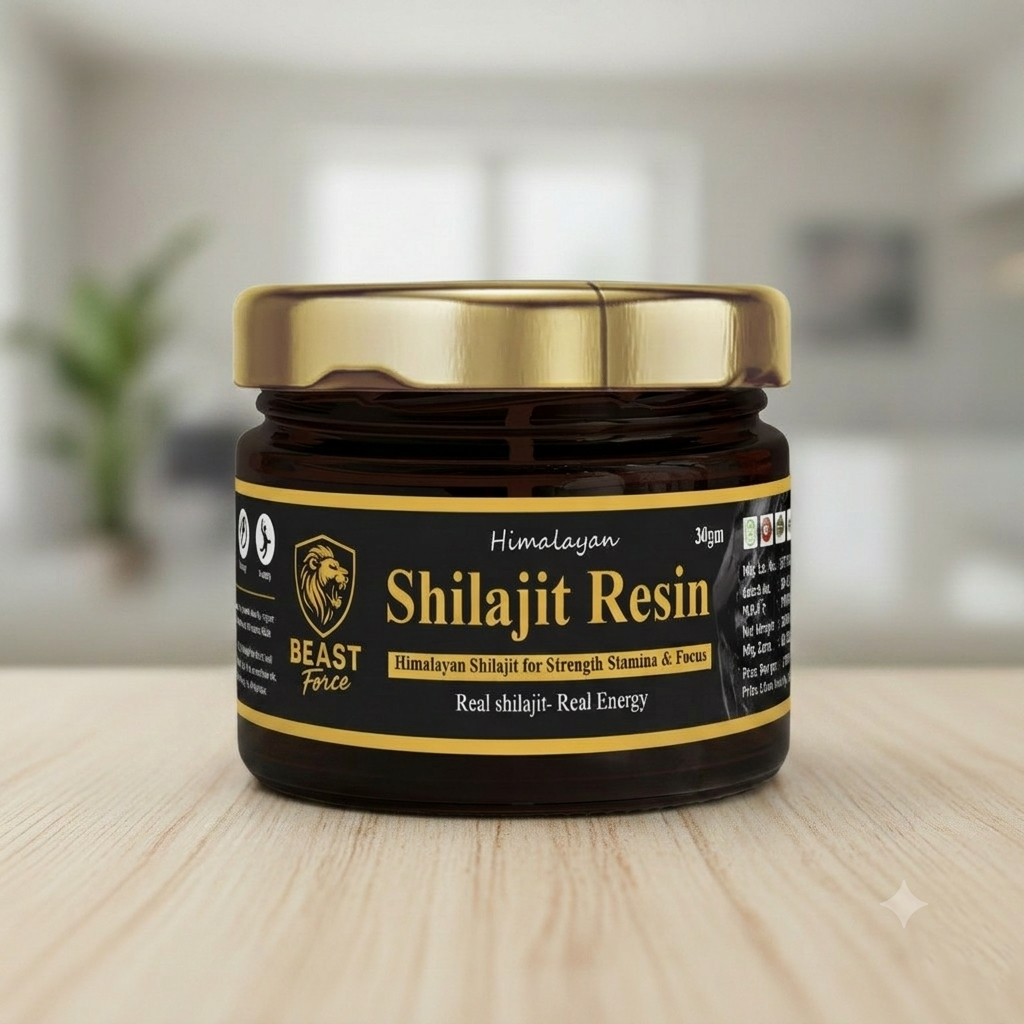
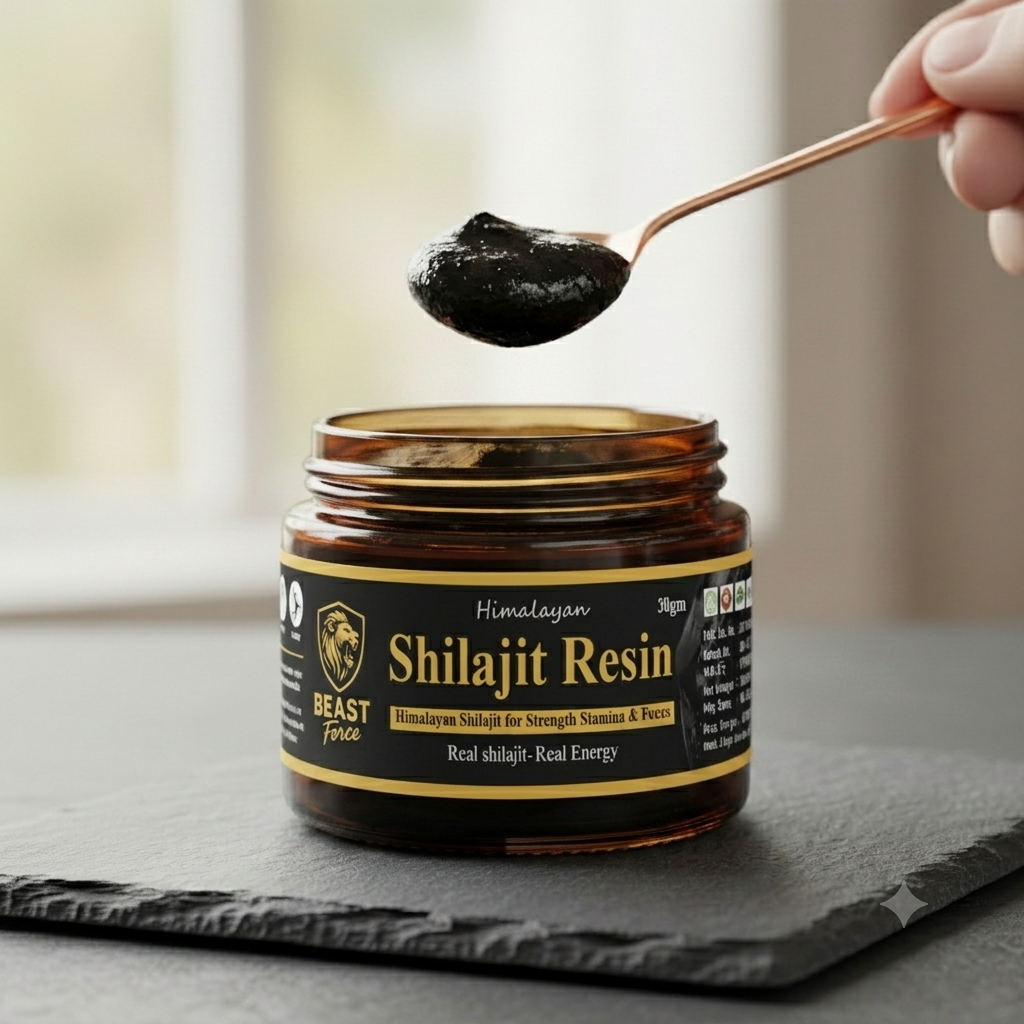
Product
BeastForce Himalayan Shilajit Resin
Form
Shilajit Resin
Category
Ayurvedic Proprietary Medicine
Composition as stated
Each 1g contains Shilajit Resin (Asphaltum Punjabinum) 900mg.
Manufactured by
Bansiwala Khadi Gram Udyog Herbal Products, Jagadhri, Haryana
Marketed by
Ayuvalent Enterprises, Delhi
Manufacturing licence
Mfg. Lic. No. 557/ISM/HR
Batch and expiry details are provided on the product pack. They are not printed as a current batch number on this page. Directions for use and storage are the ones on the pack: a pea-sized amount (250–500mg) with milk, water, tea or a fruit smoothie, as directed on the pack or by a physician, and the container kept tightly closed and stored as the label says.
BeastForce does not publish a certificate of analysis, a NABL certificate, a mineral assay, or a fulvic-acid percentage. If you want paperwork for a batch, ask before you order and match it to the pack. Nothing on this page adds a test result.
The two pack pages are Shilajit Resin 30g and Shilajit Resin 15g. Prices and order steps are stated there, not in this guide.
12. FAQ
You can inspect the pack and notice how the resin looks, smells and behaves in water. Those are observations. A home check does not prove that Shilajit resin is authentic, pure or safe.
No. Softening, dispersing or leaving residue in water does not identify the material, measure how much Shilajit is present, or detect contaminants. It is not a real-versus-fake test.
No. Colour, texture and smell help you describe what you received. They do not prove Shilajit authenticity, purity or safety.
For an Ayurvedic medicine, Rule 161 of the Drugs Rules, 1945 includes the product name, a metric net content, the manufacturer’s name and address, the manufacturing licence number, a batch number and the date of manufacture, along with the ingredient list. Rule 161B requires the expiry date to be displayed conspicuously. Read the current text of the Rules and the pack itself.
A certificate of analysis is a laboratory document for a stated sample. A useful report names the laboratory, the sample, the tests and the results. It is not a slogan on a product page. BeastForce does not display a COA on this website.
Not by itself. NABL accredits laboratories for a defined scope of tests. It does not test products. Read which parameters the report covers and whether the sample is tied to the batch on your pack.
The product pages state that BeastForce Himalayan Shilajit Resin is manufactured by Bansiwala Khadi Gram Udyog Herbal Products, Jagadhri, Haryana, and marketed by Ayuvalent Enterprises, Delhi. The manufacturing licence shown on the site is Mfg. Lic. No. 557/ISM/HR.
Batch and expiry details are provided on the product pack. This page does not publish a live batch number.
No. This website does not publish a certificate of analysis, a NABL certificate, a mineral assay or a fulvic-acid percentage for BeastForce Shilajit Resin. Do not read this guide as evidence of laboratory testing.
Sources
- Central Drugs Standard Control Organisation, The Drugs Rules, 1945 (PDF). Rule 161 (labelling of Ayurvedic, Siddha and Unani drugs) and Rule 161B (expiry).
- National Accreditation Board for Testing and Calibration Laboratories, Introduction. NABL accredits laboratories; it does not itself test products. Testing-laboratory accreditation is described against ISO/IEC 17025.
- Ding R, He S, Wu X, Zhong L, Chen G, Gu R. Efficient generation of HPLC and FTIR data for quality assessment using time series generation model: a case study on Tibetan medicine Shilajit. Frontiers in Pharmacology. 2024. PMC11608951. Cited for the limits of appearance-based grading. Not an Indian legal standard and not a BeastForce result.
- Physicochemical discussion of a Shilajit sample, PMC12703986. Cited only to show that published lab work treats solubility as one measurement among others. The sample’s numbers are not a specification for products sold in India and are not BeastForce results.
This page is a buying guide. It is not legal advice, not a licence check, and not personal medical advice.